

Advances in dental materials and craftsmanship have made denture care more reliable and natural-looking than ever. While dental implants and fixed bridgework provide long-term, fixed options for many patients, removable dentures still offer a flexible, proven solution for restoring a complete smile and returning everyday function.
At the office of Portia J. Bell, DDS Inc., we design dentures using high-quality materials and careful laboratory work to achieve a precise fit, balanced bite, and an appearance that complements each patient’s facial proportions. Our approach focuses on restoring comfort, speech, and chewing ability while preserving a natural look.
We tailor every denture plan to a patient’s oral health, lifestyle, and goals. Whether you need a partial denture to fill gaps left by a few missing teeth or a complete denture for an entire arch, our team takes the time to explain your options and to create a prosthesis that performs reliably from day one.
Tooth loss isn’t just an aesthetic issue; it changes how your mouth functions and how your face looks over time. When teeth are missing, the surrounding teeth can drift, chewing patterns shift, and the jawbone receives less stimulation. These changes can make eating less comfortable and, left unchecked, can accelerate further bone and tooth loss.
Beyond the physical effects, missing teeth often influence social comfort and self-image. People with gaps or an incomplete smile may avoid social situations, alter their speech, or choose softer foods that don’t provide the same nutritional variety. Addressing tooth loss comprehensively helps restore both function and confidence.
Replacing missing teeth sooner rather than later helps limit these ripple effects. Partial and full dentures are effective, noninvasive ways to restore bite support and facial contours, and they can be planned to work with any future treatments you may choose, such as implant support or fixed restorations.

Dentures are removable dental appliances that replace missing teeth and the tissues that surround them. They consist of lifelike artificial teeth set into a base that rests on the gums. Properly made dentures restore your ability to speak and chew while supporting the lips and cheeks to preserve facial shape.
One of the strengths of removable dentures is their versatility. A partial denture can bridge gaps when some natural teeth remain, while a full denture replaces an entire upper or lower arch. Dentures also allow for easy cleaning of both the prosthesis and the underlying oral tissues, which supports long-term oral health.
While fixed solutions such as bridges and implant-retained crowns are excellent choices for many, removable dentures remain an important, conservative option. They can be fabricated relatively quickly, modified as tissues change, and used in combination with other restorative approaches when needed.
Selecting the right denture starts with a thorough evaluation of your remaining teeth, gums, and jawbone. We look at bite relationships, soft tissue contours, and any areas that may require extra preparation. Your daily habits, speech patterns, and cosmetic preferences also guide the design so the final appliance feels and looks natural.
The two broad categories of removable dentures are full (complete) dentures and partial dentures. Full dentures replace all the teeth in an arch, while partial dentures replace one or more teeth and use existing teeth for support. Both types can be tailored with different base materials, tooth shapes, and attachment methods.
Full dentures restore an entire upper or lower arch. Their success depends on a stable fit against the gum tissues and careful attention to jaw relationships so chewing feels secure and speech is clear. Design choices include tooth shade, tooth form, and base contour to match the patient’s facial features and preferences.
A conventional full denture is made after extractions and once the tissues have healed, allowing for a stable, well-fitting appliance. An immediate denture can be placed at the time teeth are removed so you never go without teeth; however, immediate dentures usually require adjustments and occasional relines as the mouth heals and changes shape.
Immediate denture
This option allows you to leave the dentist’s office with teeth in place the same day any required teeth are removed. Because healing and tissue changes follow extractions, the fit of an immediate denture often needs to be refined over time.
Overdenture
An overdenture gains additional support from remaining natural tooth roots that are specially prepared or from attachments, improving stability while preserving bone under those roots.
Implant-supported denture
Implant-supported dentures connect to dental implants placed in the jaw. These attachments provide superior retention and reduce movement during chewing, which can be especially helpful for lower-arch prostheses.
Partial dentures replace several missing teeth while relying on remaining healthy teeth for support. They can prevent unwanted shifting of adjacent teeth, restore bite balance, and improve chewing efficiency. Modern partial frameworks are lighter and more discreet than older designs.
Materials for partial dentures range from traditional cast metal frameworks to flexible resins and hybrid designs that prioritize comfort and aesthetics. The choice depends on the location of the missing teeth, the condition of the supporting teeth, and your expectations for appearance and function.
Our goal is to design a partial or full denture that integrates seamlessly with the rest of your mouth so daily life, from speaking to smiling, feels natural and secure.
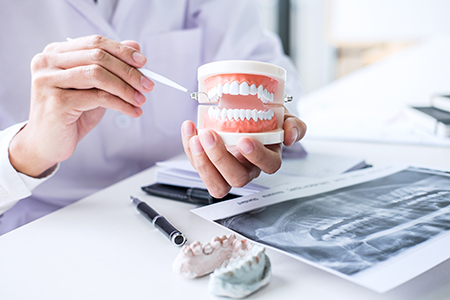
Successful denture therapy begins with careful planning. We review your medical and dental history, take diagnostic images when appropriate, and perform an oral exam to assess gum health and bone support. When existing teeth require extractions or other preparatory work, those steps are coordinated to support the best long-term fit for your denture.
Clinical impressions, try-in appointments, and laboratory communication are all critical steps in creating a denture that fits comfortably and functions well. Our team places emphasis on balanced occlusion (the way upper and lower teeth come together) and on making aesthetic choices that blend with your facial features.
When extra retention is needed, we may recommend designs that incorporate attachments to implants or to remaining tooth roots. These hybrid approaches combine the removability of a denture with the stability of anchored support, and they can be planned in stages to fit your clinical situation and goals.
Throughout planning and fabrication, the team at Portia J. Bell, DDS Inc. works closely with skilled dental technicians to ensure materials, color, and contours match the expectations set during consultations.

Adjusting to a new denture is a process; many patients notice differences in speech and chewing at first, but these changes usually resolve with consistent wear and practice. We recommend starting with soft foods and gradually reintroducing firmer textures, and we encourage you to speak aloud and read to help your tongue and lips adapt.
Initial saliva changes and occasional sore spots are common during the first days or weeks. If irritation develops, timely adjustments help relieve pressure and improve comfort. Routine checkups let us monitor tissue health and make refinements as needed.
Cleaning and maintenance are straightforward but essential. Rinse dentures after meals, brush them daily with a nonabrasive denture brush, and soak them overnight when recommended. It’s equally important to care for any remaining natural teeth and the soft tissues in your mouth to preserve oral health.
Over time, the shape of the jaws and gums can change. Regular clinical reviews help determine when a reline, adjustment, or replacement is needed so your denture continues to fit well and support comfortable function.
In every phase of care, our priority is to help you enjoy a secure, attractive, and functional denture. If you have questions about which approach is right for your mouth or how to care for a new prosthesis, our team is ready to explain options and next steps.
If you’d like more information about dentures and the treatments we provide, please contact our office for a consultation. We’re happy to discuss your needs and help you choose the solution that best restores comfort, function, and confidence.
Dentures are removable prosthetic appliances that replace missing teeth and the surrounding oral tissues. They consist of lifelike artificial teeth set into a gum-colored base that rests on the alveolar ridges or remaining teeth. Properly made dentures restore chewing function, support facial contours, and help with clear speech.
Dentures can be designed as full appliances for an entire upper or lower arch or as partials that use remaining teeth for support. They provide a conservative option that can be adjusted as tissues change and can be combined with other restorations when appropriate. Routine care and periodic professional reviews are essential to maintain fit and protect overall oral health.
Removable dentures are broadly categorized as full (complete) dentures and partial dentures, each tailored to the number of teeth being replaced and the condition of the supporting mouth structures. Full dentures replace all teeth in an arch and rely on tissue support and suction, especially for upper prostheses, while partial dentures restore one or more teeth and use natural teeth for retention. The choice depends on clinical findings, cosmetic goals, and functional needs.
Within these categories there are variations such as conventional and immediate full dentures, overdentures that use prepared tooth roots for extra support, and flexible partials made from modern resin materials. Immediate dentures are placed at the time of extractions so a patient does not go without teeth, whereas conventional dentures are fabricated after tissues have healed. Each approach has clinical trade-offs related to fit, healing, and the need for adjustments.
Implant-supported dentures are another option that uses dental implants and attachments for enhanced retention and stability, which can be particularly beneficial for lower-arch prostheses. These designs can be removable or fixed depending on the attachment system and patient preference. Your dentist will recommend the style that best balances function, maintenance, and long-term oral health.
Good candidates for dentures include people who have lost multiple teeth, have progressed dental disease, or have teeth that cannot be predictably restored. Dentures are also appropriate for patients seeking a noninvasive, reversible solution to restore chewing and appearance when fixed restorations are not feasible. A thorough evaluation of gum health, existing teeth, and jawbone support is necessary to determine candidacy and to identify any preparatory treatment that may be needed.
Age alone is not a limiting factor; rather, overall oral and medical health guide the decision-making process. Patients with stable gums and healthy tissues tend to experience better denture outcomes, while those with compromised bone or soft tissue may benefit from adjunctive measures like overdentures or implant support. Your dentist will review lifestyle, chewing needs, and cosmetic goals to design a denture plan that meets your expectations.
A conventional full denture is fabricated after any necessary extractions and once the soft tissues have healed, allowing for a stable, well-fitting appliance that reflects the healed contours of the mouth. Because tissues change during healing, a conventional denture typically offers a more predictable fit without the need for major early adjustments. This approach requires a healing period after extractions before the final prosthesis is delivered.
An immediate denture is placed at the time teeth are removed so the patient does not go without teeth during healing, but it usually requires relining and adjustments as the mouth heals and reshapes. Immediate dentures offer an aesthetic and psychological benefit of continuous tooth replacement, yet they can loosen or develop pressure areas as swelling subsides and bone remodels. Regular follow-up visits are essential to refine fit and comfort during the healing phase.
Implant-supported dentures attach to dental implants to provide superior retention and reduce movement during function, which can improve chewing efficiency and patient confidence. These prostheses may be fixed or removable depending on the design and attachment type, and they can preserve jawbone by transmitting functional forces to the implants. Implant support is often recommended when greater stability is needed or when conventional denture retention is insufficient.
The denture treatment process begins with a comprehensive exam, review of medical and dental history, and diagnostic imaging when indicated to assess bone and tissue support. Accurate impressions and bite records are taken to capture the relationship between the upper and lower jaws, and these records guide tooth position and occlusion. Communication between the dental team and the laboratory technician is critical to achieve the esthetics and function discussed during consultation.
At the office of Portia J. Bell, DDS, care includes try-in appointments that let patients preview tooth arrangement, shade, and facial support before the final prosthesis is finished. Try-in visits are an important opportunity to refine shape, lip support, and bite so the finished denture meets both cosmetic and functional goals. Skilled laboratory craftsmanship combined with thorough clinical verification helps produce a prosthesis that fits comfortably and performs well from day one.
If preparatory procedures such as extractions, root modifications for overdentures, or implant placement are required, the steps are coordinated to promote optimal tissue healing and long-term fit. Patients are given guidance about temporary prostheses and staged appointments so transitions are smooth and predictable. Follow-up visits after delivery allow adjustment of sore spots, occlusion, and retention to ensure ongoing comfort and function.
Adaptation varies by individual but most patients notice progressive improvement over several weeks as the tongue, lips, and cheeks learn to work with the new prosthesis. Initial symptoms commonly include increased saliva production, mild soreness, and subtle changes in speech, all of which typically diminish with consistent wear and small behavioral adjustments. Practicing speech, eating soft foods, and gradually increasing wear time help accelerate adaptation and build confidence.
Some patients require more time to achieve comfortable chewing or to become fully accustomed to lower dentures, which can be less stable due to the narrower ridge. Timely adjustments by your dentist relieve pressure points and improve function; persistent problems should always be addressed rather than tolerated. Regular follow-up ensures that fit and occlusion are refined as healing or tissue changes occur.
Daily denture care includes rinsing the appliance after meals to remove food debris and brushing it gently with a soft, nonabrasive denture brush and cleaner to remove plaque and surface stains. Avoid using regular toothpaste or stiff brushes that can scratch the denture surface; instead use products specifically designed for dentures or a mild hand soap when recommended. When not in use, many dentures benefit from overnight soaking in a denture solution or plain water to prevent warping and to maintain hydration of the base material.
It is equally important to care for any remaining natural teeth and the soft tissues in your mouth by brushing and flossing as directed and maintaining routine dental visits. Never attempt to adjust or repair a denture at home; professional relines or repairs protect fit and structural integrity. Bring your denture to appointments so the dentist can evaluate wear, attachment components, and tissue health and recommend any necessary refinements.
Yes. Well-fitting dentures restore chewing surfaces and bite relationships, which helps patients reintroduce a wider range of nutritious foods that may have been avoided after tooth loss. Initially, softer and easily managed foods are recommended while you rebuild chewing strength and coordination, but most people can progress to firmer textures with practice and time. Properly designed dentures support the cheeks and lips, which also helps preserve facial contours and aids in comfortable eating.
Dentures can also improve speech by restoring tooth position and supporting the oral structures used for articulation, although some sounds may require practice to normalize. Reading aloud, practicing difficult consonants, and regular wear encourage the tongue and lips to adapt to the new contours. If persistent speech changes occur, your dentist can evaluate fit and make targeted adjustments to improve clarity.
Partial dentures are removable appliances that replace multiple missing teeth and rely on remaining teeth and soft tissues for support, while bridges are fixed restorations that span a gap by anchoring to adjacent teeth. Bridges require preparation of the abutment teeth to support the pontic, whereas partial dentures preserve tooth structure by using clasps or precision attachments. Implants, by contrast, are surgically placed into the jawbone and can support single crowns, fixed bridges, or implant-retained dentures with the benefit of bone preservation and increased stability.
The choice among these options depends on the condition of adjacent teeth, jawbone quality, hygiene needs, and the patient’s long-term treatment goals. Partial dentures are often the most conservative and easily modified solution, while bridges and implants offer fixed alternatives that may simplify daily maintenance for some patients. Your dentist will review the pros and cons of each approach and recommend the option that best fits your oral condition and lifestyle.
Over time the shape of the jaws and gums naturally changes due to bone remodeling and tissue shifts, which can cause dentures to fit less securely and create sore spots or functional limitations. Signs that an adjustment or reline is needed include looseness, difficulty chewing, persistent sore areas, and changes in speech or facial support. Addressing these issues promptly reduces irritation and helps maintain oral health.
Relining replaces the tissue-contacting surface of a denture to improve adaptation to the current contours of the mouth, while rebasing or replacement may be recommended when wear or material breakdown affects function and appearance. Repairs are sometimes necessary if the denture fractures or an attachment component wears out, especially for implant-retained designs. Regular clinical reviews allow your dentist to monitor fit, recommend relines, and determine the appropriate time for a partial or full replacement so the appliance continues to meet your needs.
Routine follow-up visits also provide an opportunity to assess underlying oral health, check for changes that could affect future restorative planning, and confirm that hygiene and maintenance practices are effective. Staying proactive with appointments helps extend the useful life of a denture and ensures safe, comfortable function for daily activities. If you notice new or worsening problems between visits, contact the practice to schedule a timely evaluation.
Phone:
Fax:
(614) 532-7282
